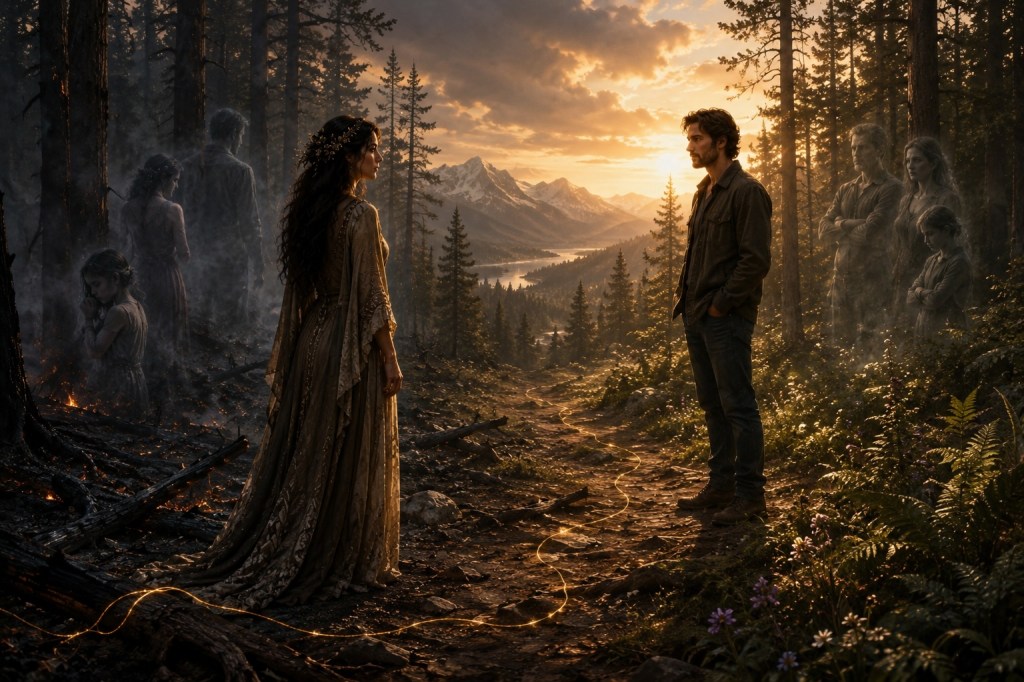
The mountains didn’t ask what had happened to us. They rose from the Montana earth with the quiet confidence of something that had watched generations of people lose one another, find one another, and mistake one another in between. Pines swayed in a wind that carried centuries instead of urgency. Rivers continued carving their patient paths through stone, unmoved by heartbreak or reconciliation. Nature has always possessed a remarkable indifference to human timelines. It simply continues becoming itself.
By the time we arrived in Montana, nearly two months had passed since April had cracked open a life I thought I understood. On paper, we were healing. The difficult conversations had begun. The silence that once stretched between us had slowly given way to curiosity. We were laughing again, taking long drives without needing a destination, discovering that ordinary moments often carried more healing than extraordinary ones ever could. Somewhere along those winding roads, I found myself looking across the truck with a thought so quiet it almost slipped past unnoticed: There you are.
That simple recognition caught me by surprise because it didn’t feel like rediscovering someone. It felt like finally seeing the person who had been standing in front of me all along. Looking back, I don’t think either of us had been seeing one another clearly. We had been looking through forests we didn’t realize we were carrying, each landscape planted long before our paths ever crossed.
As therapists, we have language for this. We talk about attachment, schemas, projection, implicit memory, and protective adaptations. They are useful words that help explain why the past so often insists on introducing itself during present-day conversations. Outside the therapy room, however, I find myself returning to a different language. I think of them as ghosts. Not because they are supernatural, but because they possess an extraordinary ability to borrow the faces of the living. They stand quietly between two people, convincing each that they are seeing what is in front of them when, in truth, they are looking through the translucent outline of someone who came long before.
It would take months before we could name what had happened. Somewhere in the middle of our conversations came a realization that stopped me in my tracks. I wasn’t being seen as the woman standing there in 2026. Instead, I had been cast into a role that belonged to another time, another story, perhaps even another person entirely. I had become a character in a narrative I didn’t write, carrying accusations that had never belonged to me. It is profoundly disorienting to spend months trying to defend yourself against a version of you that exists only in someone else’s inner world.
One of the beliefs that has quietly anchored my life is that every person deserves the freedom to walk their own path. I have never believed love requires agreement. Two people can stand beneath the same canopy, admire entirely different trees, and both be telling the truth about what they see. Differences have never threatened me. If anything, they have always made the walk more interesting. Yet there were moments when my differing perspective was received as judgment, as though disagreement itself carried the weight of criticism. I remember thinking, How did we arrive here?Not because I questioned the relationship, but because I couldn’t find myself inside the story that was unfolding.
It has taken me months to understand that I wasn’t fighting another person. I was standing in a forest where ghosts had quietly mistaken me for someone else. The deeper truth, however, is that I was wandering my own haunted woods as well. While one past was painting me into a portrait that was never mine to wear, another was awakening old echoes inside me, convincing my nervous system that history had returned wearing different clothes. Memory has never been particularly concerned with calendars. Give it enough resemblance, and it will happily convince you that two entirely different paths lead to the same destination.
Maps Drawn by Other Hands
I used to think ghosts belonged to abandoned places: old houses, empty hospitals, and forgotten battlefields where history still whispered through cracked stone walls. Somewhere along the way, I realized I had been looking in the wrong places. Ghosts are far less interested in buildings than they are in people. They rarely announce themselves with rattling chains or flickering lights. Instead, they arrive dressed as certainty. They convince us that we already know what someone means before they have finished speaking. They slip quietly between two people who genuinely love one another and begin translating every word into a language neither person intended to speak.
The longer I sat with what had happened between us, the more I began to wonder whether it had ever truly been about the present. Perhaps we had each wandered into the relationship carrying maps drawn by people who had never met the other. One map had been sketched in the shadow of criticism, where love often arrived hand in hand with judgment and approval had to be earned before it could be trusted. The other had been drawn after betrayal, where silence became dangerous and uncertainty learned to masquerade as abandonment. Neither map was wrong. They had simply been drafted for forests we were no longer walking through.
It is a curious thing to realize that someone can respond to a version of you that exists only inside their own memories. There is no courtroom where you can present evidence and no carefully chosen explanation capable of dismantling a story that was written long before you entered the scene. You can spend months trying to prove that you are kind to someone who has learned to expect criticism, just as you can spend months trying to convince yourself that you are safe when your own body has decided uncertainty is abandonment wearing a quieter face.
For a long time, I found myself asking a question that could never be answered because it wasn’t the right question: Why doesn’t he see me? It seemed reasonable enough. After all, I knew my own heart. I knew I wasn’t trying to control him or persuade him into becoming another version of me. If anything, one of the deepest joys in loving another human being is watching them become more fully themselves. I have always believed that every person deserves the dignity of choosing their own trail, even if it winds somewhere I would never think to walk.
Eventually, a different question found me: What if he isn’t looking at me at all? That question changed everything.
It did not excuse the pain. Being misunderstood still hurts. Being cast into a role that isn’t yours still leaves bruises, even when no one intended to inflict them. But compassion has an odd way of entering through doors that certainty keeps locked. Once I stopped trying to convince someone that I wasn’t the person they feared, I became curious about the fear itself. Not because it was mine to fix, but because understanding has a way of softening the sharp edges of suffering.
The irony, of course, is that while I was beginning to recognize the ghosts standing behind him, I had completely overlooked the ones standing behind me. They were quieter and far more convincing. They didn’t tell me I was being judged. They whispered something more ancient: You’re being left again.
By July, those whispers had become loud enough to echo through moments that had nothing to do with April. A difficult day no longer belonged only to the present. It pulled threads from years earlier, weaving together stories separated by more than a decade until my nervous system could no longer tell one from the other. Memory is a curious storyteller. Give it the faintest resemblance to an old wound, and it will confidently insist that you have returned to the very same forest, even when the trees around you have changed.
Perhaps that is what survival remembers best: not dates, but danger.
When the Echoes Returned
By the time July arrived, I believed the hardest part was behind us. Healing had begun to find its rhythm in the ordinary. We were talking again instead of talking around one another. We had found our way back to laughter, shared dreams, and the simple comfort of existing in the same space without every silence feeling like a threat. If healing had a soundtrack, it would not have been dramatic. It would have sounded like coffee brewing in the morning, long drives with no destination, and conversations that wandered the way rivers do, taking their time because there was nowhere urgent to be.
Then, almost without warning, the forest changed, not around me but within me.
Anyone who has spent enough time in the woods knows there is a moment when the light shifts. Nothing tangible has happened. The trail hasn’t disappeared, and the trees haven’t moved, yet every instinct quietly begins scanning the undergrowth. The body notices what the mind has not yet named: a snapped branch, a bird that has suddenly gone silent, the almost imperceptible feeling that something unseen has entered the landscape.
That was how July arrived.
Nothing catastrophic happened that day. No great argument unfolded. No doors slammed. The relationship itself had not suddenly become fragile again. If anything, we had been growing closer. Yet my nervous system had quietly wandered onto an older trail, one it recognized long before my conscious mind understood where it was going.
The stories began returning with remarkable confidence. Maybe April had meant more than he later said it did. Maybe when he spoke about needing separation, he really had intended to leave, only changing course after seeing the devastation it caused. Maybe the silence had never been uncertainty at all. Maybe it had been indifference.
One thought reached for another until they became impossible to separate, weaving themselves together with memories from sixteen years earlier. My mind no longer cared which pain belonged to 2010 and which belonged to 2026. It gathered them together as though they had always been chapters of the same story, inviting me to read them as proof that history rarely changes its ending.
The strangest part of healing is discovering that the mind can continue telling yesterday’s story long after life has begun writing a different one.
As I sat with those thoughts, I realized something that caught me completely off guard. The deepest wound I was carrying wasn’t simply the fear that someone I loved might leave. It was the feeling of having been left alone inside uncertainty. There is a particular loneliness that comes from trying to make sense of silence when the person you most need clarity from has stepped beyond your reach. The imagination is astonishingly efficient at filling empty spaces. Unfortunately, it has very little interest in accuracy.
Looking back now, I don’t think my nervous system was asking, Is this relationship safe? It was asking something much older: Am I safe to love this deeply again?
Those are very different questions. One can be answered by another person. The other asks something only time, trust, and countless ordinary moments can begin to answer.
That realization changed the way I understood my own pain. I stopped seeing it as evidence that healing had failed and began recognizing it for what it was: an old guardian standing at the edge of the forest, convinced it was still protecting me from a danger that had already passed. It wasn’t trying to sabotage love. It was trying to prevent another unbearable loss. The tragedy was that it could no longer distinguish between the fire it remembered and the sunlight filtering through the trees before it.
Perhaps that is one of the quietest truths about healing: the parts of us that create the most suffering are often the very parts that once worked tirelessly to keep us alive.
Three Ghosts, Three Guides
The longer I lived with those questions, the more I found myself wandering back to the old myths. I have always loved mythology, not because I believe the stories literally happened, but because they continue happening every day. Human beings have changed our clothes, our technology, and our vocabulary, yet somehow we continue finding ourselves in the same ancient landscapes. We still descend into underworlds. We still wander labyrinths. We still mistake ghosts for the living. Perhaps that is why these stories have survived. They are less interested in history than they are in the landscapes of the human heart.
The first story that found me was Psyche’s.
For years, I thought her story was about love. This spring, I realized it was really about uncertainty. Left alone in the darkness with only fragments of information, Psyche did what so many of us do when clarity disappears. She began trying to make meaning from silence. Fear has always been remarkably gifted at storytelling. It whispers that what we cannot see must surely be dangerous. It fills empty spaces with imagined endings and convinces us they are memories rather than predictions.
Looking back, I can see how easily my own mind became a storyteller during those months. In the absence of clarity, it began writing explanations. It reached backward through time, gathered old griefs into its arms, and returned carrying them as evidence that the story already knew how it would end.
Then Cassandra quietly stepped forward.
As a therapist, I have often thought about how painful it must be to hold a truth that cannot be received. This time, I understood it differently. There is a peculiar loneliness that comes from knowing your own heart while realizing someone else is responding to a version of you that doesn’t exist. I knew I wasn’t trying to control. I knew I wasn’t judging. I knew that loving someone has never meant asking them to become more like me. Yet there are moments in every relationship when our words arrive carrying one meaning and are received carrying another. We speak from the present while another person’s past quietly translates every sentence before it reaches them.
It is difficult to describe what it feels like to stand inside that kind of misunderstanding, not because you doubt who you are, but because you begin wondering whether the person standing across from you has ever truly been able to see you through the fog.
Then, almost imperceptibly, Ariadne entered the story carrying nothing more than a simple thread.
Perhaps that is why I have always loved her most. Heroes are often remembered for their swords, their strength, or the monsters they defeated. Ariadne offered something quieter. She understood that surviving a labyrinth was never about overpowering it. It was about finding a way to remain connected to what was true while everything around you insisted you were lost.
That thread became a different way of understanding the months behind us.
Healing didn’t arrive because one conversation suddenly explained everything. It wasn’t hidden inside a grand apology or a single breakthrough that untangled every misunderstanding we had ever carried. Instead, it revealed itself one small thread at a time: an honest conversation that lingered a little longer than the one before it, a moment of curiosity where certainty might once have taken over, a difficult truth spoken gently enough that it could finally be heard instead of defended against.
Looking back now, I don’t think we found our way out of the labyrinth because either of us suddenly became fearless. We found our way because we kept choosing not to let go of the thread, even when neither of us could yet see where it was leading.
Perhaps that is why these myths continue to endure. They remind us that the monsters we fear, the truths we struggle to speak, and the paths we fight to find are rarely separate stories. More often than not, they are different chapters of the same journey. Sometimes we are Psyche, trying to make sense of a darkness we cannot yet see through. Sometimes we are Cassandra, longing to be known as we truly are instead of as someone else’s history imagines us to be. And sometimes, if we are fortunate, we become Ariadne for one another, offering neither certainty nor rescue, but a simple thread that whispers, Keep walking. I’m still here.
Seeing the Living Again
There is an old saying that we do not see the world as it is. We see it as we are. I have always appreciated the sentiment, but I don’t think it tells the whole story. Sometimes we don’t see the world as we are. Sometimes we see it as we once had to become.
That distinction has quietly changed the way I understand people.
I no longer think most misunderstandings begin with malice. More often, they begin with protection. Somewhere along the way, each of us learned which dangers to scan for. Some learned to watch for criticism. Others learned to brace for abandonment. Some became experts at anticipating anger, disappointment, rejection, or shame. We become fluent in the language of the wounds that first taught us how to survive. The tragedy is that survival rarely updates its vocabulary. It continues speaking yesterday’s language long after the conversation has changed.
I think that is why love can become so bewildering.
Two people can stand beneath the very same canopy, looking at the very same moment, while inhabiting entirely different realities. One person hears, I’m disappointed in you. The other is saying, I’m simply seeing something differently. One person reaches for space to gather their thoughts. The other experiences that same space as the first step toward being left behind. Neither experience is imaginary. Both are profoundly real to the nervous systems carrying them.
As therapists, we spend years helping others untangle yesterday from today, inviting them to notice when an old story has quietly stepped into the present wearing a familiar face. Yet insight becomes considerably less cooperative when we are standing inside our own lives. Apparently, insight and participation are distant cousins. They know one another, but they rarely arrive at the same family gathering.
That realization softened something in me. I became less interested in deciding who was right and more curious about a different question: What old story entered the room before either of us did?
There are still moments when April reaches for my hand before I realize where we are walking. There are still days when my mind quietly rehearses endings that are no longer unfolding. Healing, I’ve discovered, is rarely the absence of old stories. It is recognizing their voices before handing them the pen.
That has become one of the gentlest practices of my own rewilding. When fear begins narrating the landscape, I try not to argue with it. Fear is rarely persuaded by debate. Instead, I have learned to become curious. Whose voice is this? What season of my life first taught me this story? Am I standing in today’s forest, or have I wandered onto an old trail without realizing it?
Those questions have changed far more than certainty ever did.
Perhaps that is what Ariadne’s thread really is: not certainty, but curiosity. It is a willingness to keep walking without pretending we already know what waits around the next bend.
That curiosity is what finally allowed me to see the person beside me again, not as a collection of old fears or unfinished stories, but as someone carrying a forest every bit as complex as my own. We were never enemies wandering the same woods. We were two travelers, each trying to navigate landscapes planted long before we ever met.
The realization didn’t erase the ghosts. It simply reminded me that ghosts lose much of their power the moment we recognize them for what they are. The living, on the other hand, deserve to be met as they are, not as our history remembers them, but as they stand before us today.
The Forest Chooses What Grows
A few weeks after returning from Montana, I found myself thinking about seeds.
Not because I had suddenly taken up gardening, although anyone who knows me knows I am far more likely to admire a forest than successfully keep a houseplant alive. It was because I couldn’t shake the image of standing in a woodland after a fire, looking across a landscape that appeared, at first glance, empty. The untrained eye might believe nothing remained beneath the ash. Nature, however, has never been particularly interested in first impressions.
Some seeds spend years waiting. Some cones remain sealed until the heat of fire loosens them. What looks like destruction from above can become, beneath the surface, the beginning of something else. The very fire that appears to have ended the forest may become the catalyst that allows new life to emerge.
I have thought about that often since April.
Not because I believe pain is inherently beautiful. I don’t. There is nothing romantic about standing in the middle of uncertainty, wondering whether the life you thought you were building is quietly coming undone. I would never wish that kind of anguish on another person. Yet I have also come to believe that pain, like fire, reveals more than it creates. It exposes what has been waiting beneath the surface all along.
That realization forced me to ask a question I had been carefully avoiding: What was I watering?
Beneath every relationship lies an entire ecosystem of unseen seeds. Some grow into trust. Others into resentment. Some become tenderness, while others quietly send roots into fear. None of them announce themselves when they first enter the soil. They wait, sometimes for years, responding less to our intentions than to our attention.
I realized I was carrying two very different gardens.
One was filled with the ordinary moments that had slowly brought us back to one another: long conversations, shared laughter, Montana skies that seemed large enough to hold both grief and hope at the same time, and quiet mornings that asked nothing of us except to be present. These moments were real. They deserved water.
The other garden was fed by replaying the moments when I had felt abandoned inside uncertainty. My mind returned to them with remarkable dedication, turning them over like stones in a river, convinced that if I examined them one more time I might finally discover the explanation that would allow me to rest. Instead, each return gave those memories a little more sunlight, a little more rain, and a little more room to grow.
It is a humbling thing to realize that the mind often mistakes repetition for resolution. We revisit the same hurt believing we are healing it when sometimes we are simply rehearsing it.
That doesn’t mean we ignore pain or pretend it never happened. Forests don’t survive by denying where the fire burned. The charred trunks remain part of the landscape. They become habitat for new life. Moss grows across blackened bark. Ferns root themselves where flames once climbed. The scar is not erased. It is integrated.
Perhaps relationships ask something similar of us. They do not ask us to forget or pretend. They ask us to become intentional about what receives our attention after the fire.
There are still days when an old echo wanders through my thoughts. There are moments when uncertainty taps gently on the door, inviting itself back inside as though it still lives here. When that happens, I no longer assume it is telling me the truth. I have begun greeting it the way I greet a familiar bird passing through the trees. I notice it. I acknowledge it. Then I let it continue on its way without building a home for it beneath my canopy.
That, more than anything, feels like rewilding. It is not the absence of old wounds, but the quiet practice of choosing, again and again, which parts of the forest we will tend.
If You Find Yourself in This Forest
Perhaps you have recognized something of your own life in these pages. Maybe you have looked across a room at someone you love and felt certain they had become a person you no longer recognized. Maybe you have tried to explain your heart only to hear your words returned to you carrying a meaning you never placed inside them. Or perhaps you have felt your own nervous system gathering evidence from old winters, insisting that the cold moving through the present can only end the way it did before.
When that happens, the first task may not be deciding who is right. It may be noticing which forest you are standing in.
Before answering the accusation, defending your intentions, or following fear toward its inevitable conclusion, pause long enough to look around. Ask yourself whether the danger belongs entirely to this moment or whether an older landscape has quietly appeared beneath it. Notice what your body is anticipating. Is it criticism, rejection, abandonment, anger, or shame? The body often reveals the ghost before the mind is willing to admit that one has entered the room.
This does not mean dismissing your instincts or explaining away genuine harm as an old wound. Not every alarm is a memory. Sometimes the smoke really does mean something is burning. Curiosity should never require us to abandon discernment, and compassion does not ask us to remain where there is cruelty, manipulation, fear, or an absence of accountability. Before searching for ghosts, we must first be honest about whether the person standing before us is safe enough to meet in the present.
When safety exists, however, certainty may be the wrong lantern to carry. Certainty tends to illuminate only the path we have already chosen. Curiosity casts a wider light. Instead of asking, Why are you doing this to me? we might ask, What did you hear me say? Instead of insisting, You are judging me, we might risk saying, Something in me is hearing judgment, and I want to understand whether that is what you meant. Rather than assuming space means abandonment, we might ask what the space is for and what connection can remain while it is being taken.
These questions sound simple until we are frightened. Then they can feel like trying to thread a needle in the middle of a storm. It is difficult to become curious while the nervous system is assembling its armor. Sometimes the most honest thing two people can do is pause the conversation before their ghosts begin speaking for them. A pause is not the same as disappearance. It can become a promise to return after each person has found enough ground beneath their feet to speak from the present again.
It may also help to name the story before trying to solve it. The story arriving for me is that you are leaving. The story I am hearing is that I can never get this right. Naming a story does not make it false, but it creates a little breathing room between what happened and what fear has concluded. In that space, another person has the opportunity to respond to the wound beneath the defense rather than becoming trapped inside an accusation they cannot answer.
Repair also requires more than insight. Recognizing the ghosts is only the beginning. The living still have to behave differently. Clarity must replace prolonged silence. Accountability must follow harm. Reassurance must be offered in ways the other person can actually receive, not merely in the form we find easiest to give. Trust rarely returns because two people finally understand the origin of their patterns. It returns because they repeatedly create a different experience together.
Sometimes the thread is another person. A trusted therapist, wise friend, or grounded witness can help us hear what fear keeps translating incorrectly. Not every labyrinth is meant to be navigated alone. At times, we need someone outside the forest to remind us which century we are standing in and which voices actually belong to the people before us.
Most of all, resist the temptation to demand immediate certainty from a living process. You may not know at once whether you are healing, repeating, remaining, or leaving. Some truths arrive only after the nervous system has stopped shouting long enough for the quieter parts of us to speak. For a while, the next honest step may be the only map available.
Perhaps that next honest step is enough. We can ask the question beneath the accusation, name the story without declaring it fact, return when we say we will return, and notice what is being watered between us. Over time, we also learn to watch whether both people are willing to tend what continues to grow.
The way out of a haunted forest is rarely found by running faster. More often, it begins when we stop, feel the thread still resting in our hands, and look carefully at who is actually standing beside us.
Returning to the Living
I still think about Montana.
Not because it healed us. Places don’t do that. Mountains have never repaired a relationship, and rivers have never untangled the complicated histories two people carry into loving one another. They simply have a way of stripping away the illusion that human beings are the first to wander through difficult seasons. Long before either of us arrived, those mountains had watched forests burn, rivers flood, hillsides collapse, and entire ecosystems begin again. They understood something I was only beginning to learn: survival and flourishing are not the same thing, but one can become the other if given enough time.
As we drove beneath those impossibly wide skies, I found myself looking out the window more than once, watching lodgepole pines gather in clusters along the mountainsides. From a distance, they looked untouched, as though they had always stood exactly where they were. But forests are wonderful keepers of secrets. Beneath the green canopy are old lightning strikes hidden beneath bark, fallen giants slowly returning themselves to the soil, and roots so deeply intertwined that one tree often cannot survive without the quiet support of another. A healthy forest is not one that has never been wounded. It is one that has learned how to live with the memory of its storms without allowing them to become its only story.
I think people are much the same.
Looking back now, I no longer see the past few months as a story about nearly losing one another. I see it as a story about learning to recognize the ghosts we had unknowingly invited into the conversation. Some belonged to childhood. Some belonged to betrayal. Some belonged to fear. None of them belonged to the two people standing in front of each other, trying, imperfectly but sincerely, to find the courage to be known again.
That doesn’t mean every ghost has disappeared. I suspect they never fully do. The old stories still know where to find me. Occasionally they arrive without knocking, carrying familiar questions and well-rehearsed endings. The difference is that I know them now. I recognize the cadence of their voices. They no longer introduce themselves as truth. They arrive as memory. There is a quiet freedom in that distinction.
Perhaps that is what rewilding has always meant to me. It is not returning to some untouched version of ourselves that existed before life left its fingerprints behind. Forests do not grow by becoming what they once were, and neither do we. Rewilding is allowing every season, every loss, every fire, and every unexpected return to become part of the ecosystem without asking any one of them to define the whole.
When I think back to that trip now, I don’t remember a grand revelation or a single conversation that changed everything. I remember something much smaller. I remember looking across the truck and seeing the person beside me instead of the ghosts standing behind him. Perhaps, for the first time in a long while, I allowed myself to believe that I, too, was finally being seen.
The mountains never asked us to explain where we had been. They simply stood there, weathered and patient, reminding me that forests are not remembered only for the fires they survive, but for what continues to grow long after the smoke has cleared.
Author Bio
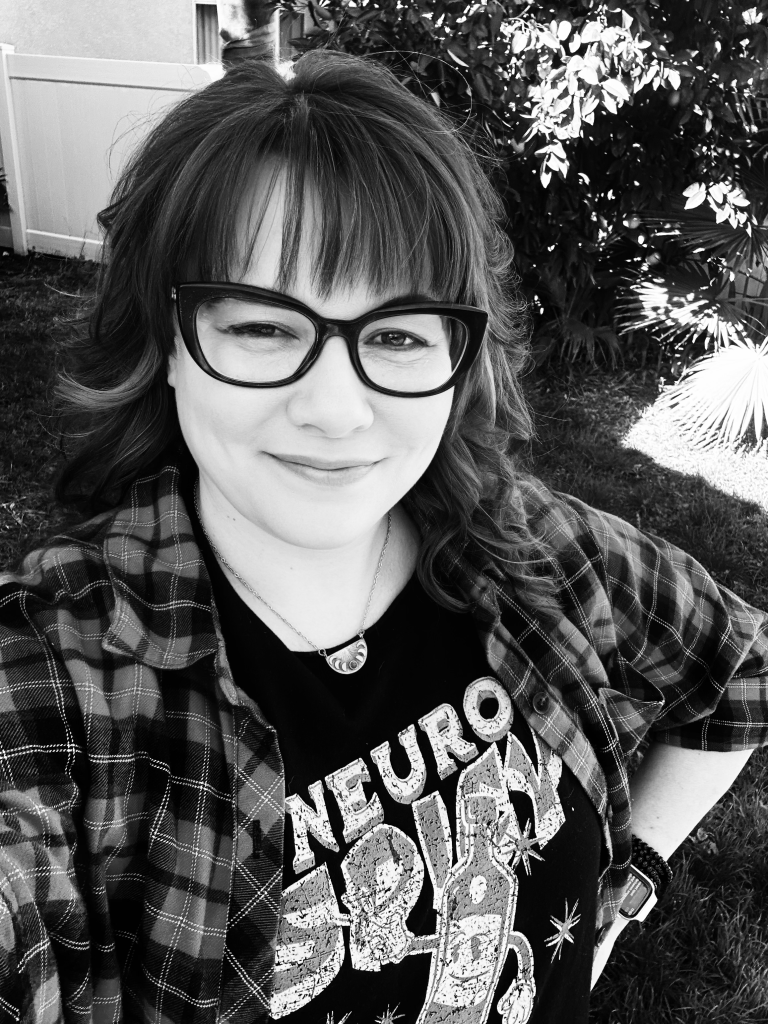
Jen Hyatt, LMFT is an author, licensed psychotherapist, podcast host, and founder of Storm Haven Counseling & Wellness in Temecula, California. Her work lives at the intersection of psychology, story, and the spaces we rarely speak out loud. She writes for those navigating identity shifts, relational complexity, and the quiet unraveling that often precedes transformation.
Through The Nerdie Therapist, Jen writes essays and hosts podcast conversations exploring rewilding, attachment, misattunement, grief, mythology, and the lifelong journey of returning to ourselves.
Jen’s approach is rooted in depth psychology, somatic awareness, and a neurodivergent-affirming lens. She is drawn to the undercurrents of human experience, the patterns beneath behavior, and the moments when something internal no longer fits the life built around it. Her work engages these themes as lived experience, moving through the body, reshaping perception, and asking for a different kind of presence.
Her work is not about becoming someone new. It is about remembering who you were before the world told you who to be.
You are not unraveling. You are shedding what was never yours.
You are not lost. You are remembering the way back to yourself.
Disclaimer
The writing shared on this website is offered for educational and reflective purposes only. It is not a substitute for therapy, medical care, or professional mental health treatment.
Although I am a Licensed Marriage and Family Therapist in California, reading this content does not establish a therapeutic relationship. The thoughts, reflections, and experiences shared here are offered as insight and perspective, not individualized clinical guidance.
If you are experiencing emotional distress, mental health concerns, or need support, I encourage you to seek care from a licensed mental health professional in your area. If you are in immediate crisis, please contact your local emergency services or reach out to the 988 Suicide & Crisis Lifeline in the United States.
This space is meant to support reflection, not replace support.
 Rewilding Self: Notes from the In-Between
Leave a comment